Mulailah

Tanpa permulaan, anda tidak akan sampai ke mana-mana.

Semangat

Semangat yang kuat mampu mengatasi apapun cobaan yang datang.

Konsisten

Lumbung emas dalam diri kamu adalah pikiran kamu. Kamu dapat menggalinya sedalam-dalamnya dan sepuas-puas yang kamu inginkan.

Pantang Menyerah

Gagal selepas usaha adalah hikmah, anda akan mendapat sesuatu yang lebih besar daripada apa yang anda sangkakan.

Be The One

Be the one is better than be the best.

Saturday, February 11, 2012

Stephen Hawking

Stephen Hawking was born January 8, 1942 in Oxford, England. From an early age, he showed a passion for science and the sky. At age 21, while studying cosmology at Cambridge, Hawking was diagnosed with Amyotrophic Lateral Sclerosis (ALS). Despite his debilitating illness, he has done ground-breaking work in physics and cosmology and his several books strive to make science accessible to everyone.

Early Life

The eldest of Frank and Isobel Hawking's four children, Stephen William Hawking was born on the 300th anniversary of the death of Galileo, which has long been a source of pride for the noted physicist. Stephen was born into a family of thinkers. At a time when few women thought of going to college, the Scottish born Isobel earned her way into Oxford University in the 1930s, making her one of the college's first female students. Frank Hawking, another Oxford graduate, was a respected medical researcher with a specialty in tropical diseases.

Stephen Hawking's birth came at an inopportune time for his parents, who didn't have much money. The political climate was also tense, as England was dealing with World War II and the onslaught of German bombs. In an effort to seek a safer place to have their first child, Frank moved his pregnant wife from their London home to Oxford. The Hawkings would go on to have two other children, Mary (1943) and Philippa (1947). A second son, Edward, was adopted in 1956.

The Hawkings, as one close family friend described them, were an "eccentric" bunch. Dinner was often eaten in silence, each of the Hawkings intently reading a book. The family car was an old London taxi and their home in St. Albans was a three-story fixer-upper that never quite got fixed. The Hawkings also kept bees in the basement, and made fireworks in the greenhouse.

In 1950, Stephen's father took work as the head of the Division of Parasitology at the National Institute of Medical Research, and spent the winter months in Africa doing research. He wanted his oldest child to go into medicine, but from an early age Stephen showed a passion for science and the sky. That was evident to his mother who, along with her children, often stretched out in the backyard on summer evenings to stare up at the stars. "Stephen always had a strong sense of wonder," she remembered. "And I could see that the stars would draw him."

Early in his academic life Stephen, while recognized as bright, was not an exceptional student. At one point in high school, his mother recalled, he was third from the bottom of his class. Instead, Stephen turned his mind loose on pursuits outside of school. He loved board games, and with a few close friends created new games of their own. At the age of 16 Stephen, along with several other buddies, constructed a computer out of recycled parts for solving rudimentary mathematical equations.

He was also on the go a lot. "Always on the move," said a family friend. "Hardly ever still." With his sister Mary, Stephen, who loved to climb, devised different entry routes into the family home. He remained active even after he entered Oxford University at the age of 17. He loved to dance, and also took an interest in rowing, becoming one of the Oxford rowing team's coxswain.

To his father's chagrin, Hawking finally said no to medicine, instead expressing a desire to study mathematics. But since Oxford didn't offer a mathematics degree, Hawking gravitated toward physics and, more specifically, cosmology.

By his own account, Hawking didn't put much time into his studies. He would later calculate that he averaged about an hour a day focusing on school. And yet, he didn't really have to do much more than that. In 1962, he graduated with honors and moved on to Cambridge University for a Ph.D. in cosmology.

http://www.biography.com/

Wednesday, February 8, 2012

Jumper Kipas (fan) Laptop

Buat agan-agan yang merasakan bertambah panasnya suhu laptop biasanya banyak yang menggunakan cooler fan untuk mengatasinya, tetapi terkadang cooler fan tidak cukup berfungsi karena tidak tepat pada bagian mana yang harus di dinginkan dikarenakan letak cooler fan pada luar mainboard laptop bukan didalam.
untuk mengatasi suhu berlebih pada laptop ada beberapa hal yang pernah saya coba menerapkannya, ini saya lakukan pada laptop jenis HP DV2000, Compaq Presario F700 dan HP DV9. berikut adalah langkahnya :
1. Bersihkan fan dari kotoran/debu yang menempel
fan yang kotor
    karena ukuran kipas kecil biasanya debu/kotoran sering menempel, bersihkan sampe kotoran tersebut hilang. untuk membersihkannya cukup dengan mengambil kotoran tersebut/menggunakan kuas
Gambar kotoran yang diambil
biasanya cukup dengan mengambil kotoran kipas akan bekerja secara maksimal.

2. Jumper fan
untuk HP DV2000, Compaq Presario F700 dan HP DV9 cukup dengan diambil/ dicopot kabel kuningnya saja, terus silahkan dicoba jika kipas nyala berarti proses jumper selesai, jika tidak nyala berarti fan tersebut memang tidak bisa di jumper.
DV2000
Semoga artikel singkat ini dapat membantu agan-agan untuk mendinginkan laptop meskipun suasana hati yang panas.


Tuesday, February 7, 2012

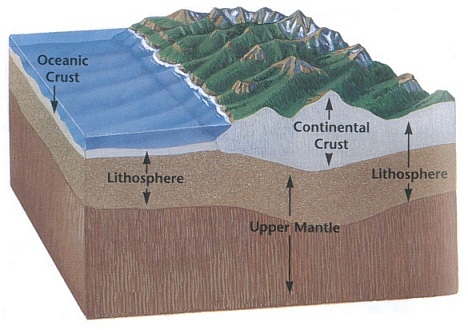
STRUCTURE OF THE EARTH'S LITHOSPHERE


In the image to the right we see a small portion of the earth's outer layers enlarged to show more detail (click picture for a larger version).
The drawing begins at the earth's surface (sea level) and descends about 150 kilometers down. There are several layers shown, color coded brown and black, green, and reddish.
The outermost brown and black layer, above the Moho (boundary between crust and mantle) is the crust. It has two major divisions: ocean basins (black layer) composed of mafic rocks (or see primer) like basalt and gabbro, and continents (brown layer) composed of felsic rocks (or see primer) such as granite. the crust extends to a depth of about 70 km, and represents less than 0.1% of the earth's total volume.
The continent in the upper center is a continental craton. A craton is a stable continent eroded down to just above sea level. Because continental cratons are composed of light weight rock such as granite they are like a boat resting in water, neither rising nor sinking on their own. They are said to be in isostatic equilibrium. Conversely, mountains of any kind must be held up by something, like heat or a root zone, or they will sink right back into the earth.
The Moho lower boundary of the crust marks the transition from the granite and basalt of the crust to the ultramafic rocks (or see igneous primer) of the mantle below.

The outer layers of the earth are subdivided on two totally different criteria, composition and behavior, and these overlap in non-obvious ways, often leading to confusion if we don't pay attention.
Compositionally, the Moho separates the crust, composed of relatively light weight felsic and mafic rocks, from the ultramafic rocks of the mantle. The felsic and mafic rocks are analagous to the light weight slag that floated to the surface during the earth's molten stage.

Behaviorally, the outer earth layers are divided into the lithosphere and asthenosphere (see right side of enlarged drawing). The lithosphere is the cold, rigid outer layers, and is composed of the crust and the outermost portion of the mantle.
The underlying asthenosphere is all ultramafic mantle, but it is hot and plastic. The convection cells operate within the asthenosphere.

more articles about earth in here

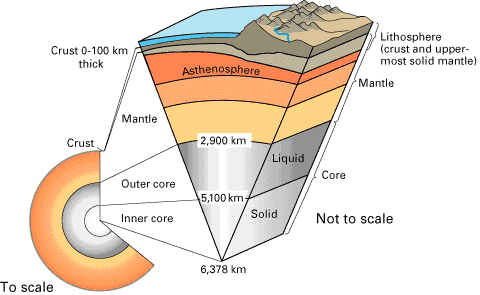
STRUCTURE OF THE EARTH

To understand plate tectonic theory, we need to know something about the structure of the earth. To understand this structure we need to know something about igneous rocks. If you are unfamiliar with igneous rocks, there is a brief primer that in two minutes will tell you everything you need to know to get started.

The earth is approximately 12,740 kilometers in diameter, and is stratified into layers as shown in the illustration to the right. The properties of each are:

Lithosphere - the outer rigid shell of the earth's structure, extending from the surface to about 1000 km deep (outer blue line on drawing). It consists of the crust and the upper mantle. Note how very thin the lithosphere is, comparatively thinner than an egg shell. It is divided into the crust (the outermost layer) and the very upper part of the mantle (explored under lithosphere structure).

Asthenosphere - the layer or shell below the lithosphere, about 2000 km thick. It is composed mostly of ultramafic rocks (or see igneous primer) such as peridotite and dunite that are weak and plastic, and flow slowly under stress.

Mantle - layer or shell of the earth below the lithosphere and above the core; it is about 2800 km thick, although it is subdivided into many sub-layers, including the asthenosphere and lower mantle as well as others. It is composed mostly of ultramafic rocks (or see igneous primer) such as peridotite and dunite and their metamorphic equivalents (e.g. ecologite).

Core - the central portion of the earth about 7000 km in diameter. It is composed of an iron-nickle alloy. The outer core is molten, while the inner core, even though just as hot, is a solid because of the increased pressure.

more articles about earth in here

Monday, February 6, 2012

Science & Islam


The Dark Age Myth

If there is much misunderstanding in the West about the nature of
Islam, there is also much ignorance about the debt our own culture
and civilisation owe to the Islamic world. It is a failure which stems,
I think, from the strait-jacket of history which we have inherited.
HRH Prince Charles in a speech at Oxford University,
27 October 1993
In 410 CE, Alaric, the Germanic king of the Visigoths, swept into Rome and sacked the great city in a three-day rampage. Sixty-six years later, Romulus Augustus, the last Roman emperor of the West, was deposed, and the regalia of empire was rudely despatched to Constantinople. With that, the lights went out on civilisation, and the Western world was plunged into an age of darkness – a night in which there was no scholarship, literacy or even civilised life. Only 1,000 years later did the world finally rediscover classical learning and bring the world’s night of darkness to an end with the bright new dawn of the Renaissance. Or so the story goes.
This is the myth of the Dark Ages, the idea that history and progress pretty much stopped for a millennium after the fall of Rome. The trouble is that the myth is just that, a myth. But it has been a myth so potent that it has thoroughly distorted our understanding of how civilisations emerge and how science and learning progress.
Advances in our understanding of the natural world happen when scientists absorb the latest knowledge in fields such as physics or biology, and then modify or improve it. They work rather like runners in a relay race, passing the baton of learning from one scientist to the next. Modern science, regarded as a hallmark of modern Western civilisation, achieved its place through the passing of many successive batons, which were handed to the scientists of Europe from those of the world’s non-Western cultures. These included those who lived in the cultures of Islam over a period of some 800 years from the 8th to the 16th centuries.
The fact that we know little of this is what Michael Hamilton Morgan of the New Foundation for Peace speaks of as ‘lost history’. The historian Jack Goody goes further and calls it ‘the theft of history’. It is as if the memory of an entire civilisation and its contribution to the sum of knowledge has been virtually wiped from human consciousness. Not simply in the West but in the Islamic world too, the achievements of Islamic scientists were, until recently, largely forgotten or at least neglected, except by a few diligent specialists such as Harvard University’s Abelhamid Sabra, David King, Jamil Ragep and George Saliba.
In mainstream science education in Britain – until very recently – the history of scientific progress has tended to leapfrog from the classical era of Euclid, Aristotle and Archimedes straight to the birth of the Age of Science in 16th- and 17th-century Europe, with only a cursory mention, if any, of the great swathe of Islamic science in between. In some versions of history, the ‘dark age’ only really ends, and the progress of science only really begins, with the famous conflict in the early 17th century in which Galileo confronts the Catholic Church with the assertion that the earth moves around the sun. As the world eventually acknowledges that Galileo is right, this is presented as the world-changing triumph of the light of reason over superstition. Thereafter, from the 17th century onwards, Western Europe’s scientists are set free to unlock the world’s secrets – William Harvey discovers blood circulation, Isaac Newton launches the study of physics, Robert Boyle pioneers the study of chemistry, Michael Faraday, electricity, and so on. And so we move forward into the Age of Reason and the dramatic progress of modern science.

for e-book click here


Sunday, February 5, 2012

Carl Friedrich Gauss: Mathematical Prodigy


Aprodigy is a highly talented child, usually called precocious or gifted, and almost always ahead of his peers.The German mathematician Carl Friedrich Gauss (1777–1855) was one such child. He often boasted that he could calculate before he could speak. By the ripe old age of three, before he had been taught any arithmetic, he corrected his father’s payroll by declaring “the reckoning is wrong.” A further check of the numbers proved young Carl correct.

As a ten-year-old student, Gauss was presented the following mathematical problem:What is the sum of numbers from 1 to 100? While his fellow students were frantically calculating with paper and pencil, Gauss immediately envisioned that if he spread out the numbers 1 through 50 from left to right, and the numbers 51 to 100 from right to left directly below the 1–50 numbers, each combination would add up to 101 (1 100, 2 99, 3 98, . . .). Since there were fifty sums, the answer would be 101 50 5050.To the astonishment of everyone, including the teacher, young Carl got the answer not only ahead of everyone else, but computed it entirely in his mind. He wrote out the answer on his slate, and flung it on the teacher’s desk with a defiant “There it lies.” The teacher was so impressed that he invested his own money to purchase the best available textbook on arithmetic and gave it to Gauss, stating, “He is beyond me, I can teach him nothing more.”

Indeed, Gauss became the mathematics teacher of others, and eventually went on to become one of the greatest mathematicians in history, his theories still used today in the service of science. Gauss’s desire to better understand Nature through the language of mathematics was summed up in his motto, taken from Shakespeare’s King Lear (substituting “laws” for “law”):“Thou, nature, art my goddess; to thy laws/My services are bound.”


Johann Carl Friedrich Gauss (30 April 1777 – 23 February 1855) was a German mathematician and scientist who contributed significantly to many fields, including number theory, analysis, differential geometry, geodesy, electrostatics, astronomy, and optics. Sometimes known as "the prince of mathematicians" and "greatest mathematician since antiquity", Gauss had a remarkable influence in many fields of mathematics and science and is ranked as one of history's  most influential mathematicians.

Saturday, February 4, 2012

Structure of The Sun


Astrophysicists classify the Sun as a star of average size, temperature, and brightness—a typical dwarf star just past middle age. It has a power output of about 10^26 watts and is expected to continue producing energy at that rate for another 5 billion years. The Sun is said to have a diameter of 1.4 million kilometers, about 109 times the diameter of Earth, but this is a slightly misleading statement because the Sun has no true “surface.” There is nothing hard, or definite, about the solar disk that we see; in fact, the matter that makes up the apparent surface is so rarified that we would consider it to be a vacuum here on Earth. It is more accurate to think of the Sun’s boundary as extending far out into the solar system, well beyond Earth. In studying the structure of the Sun, solar physicists divide it into four domains: the interior, the surface atmospheres, the inner corona, and the outer corona.


The Interior
The Sun’s interior domain includes the core, the radiative layer, and the convective layer. The core is the source of the Sun’s energy, the site of thermonuclear fusion. At a temperature of about 15,000,000 K, matter is in the state known as a plasma: atomic nuclei (principally protons) and electrons moving at very high speeds. Under these conditions two protons can collide, overcome their electrical repulsion, and become cemented together by the strong nuclear force. This process is known as nuclear fusion, and it results in the formation of heavier elements as well as the release of energy in the form of gamma ray photons. The energy output of the Sun’s core is so large that it would shine about 10^13 times brighter than the solar surface if we could “see” it.
Structure of The Sun


Thermonuclear Fusion
The nuclear fusion, now occurring in the core of the Sun, turns hydrogen nuclei into helium nuclei. In fact, that is how the elements heavier than hydrogen are made; the thermonuclear fusion at the core of stars can produce the first 26 elements, up to iron. The Sun, because of its relatively small mass, will go through only the first two stages of fusion, the hydrogen-helium stage and the helium-carbon stage.


Hydrogen-helium fusion can occur in more than one way, but in any case the temperature must be in the vicinity of 15 million K so that two positively charged particles will be moving fast enough to overcome their electrical repulsion when they collide. The density must be large, and the immense solar gravity compresses the gas so that it is ten times as dense as gold at the center of the Sun. If the two particles can get close enough together, the very short-range strong nuclear force will take effect and fuse them together. The most common fusion reaction in the Sun is shown in.
The proton-proton fusion reaction which occurs in the core of the sun at a temperature of about15,000,000 K

The Surface Atmospheres
The solar surface atmospheres are composed of the photosphere and the chromosphere. The photosphere is the part of the Sun that we see with our eyes—it produces most of the visible (white) light. Bubbles of hotter material well up from within the Sun, dividing the surface of the photosphere into bright granules that expand and fade in several minutes, only to be replaced by the next upwelling. The photosphere is one of the coolest layers of the Sun; its temperature is only to be replaced by the next upwelling. The photosphere is one of the coolest layers of the Sun; its temperature isonly to be replaced by the next upwelling. The photosphere is one of the coolest layers of the Sun; its temperature is only to be replaced by the next upwelling. The photosphere is one of the coolest layers of the Sun; its temperature is about 6,000 K

These periods can easily be determined by watching sunspots over several days
Photosof the Sun on four consecutivedays taken inH light. Features canbe seen to move as theSun rotates.

The Inner Corona
The inner corona is the wispy halo, extending more than a million kilometers out into space, that can be seen when the brilliant disk of the Sun is blocked by the Moon during a total eclipse. The cause of the high temperature of the corona, about 2,000,000 K, is not well understood. The corona is a large source of x-rays which do not penetrate Earth’s atmosphere. With instruments on satellites we can look at the corona in x-ray wavelengths and see many details that do not appear in visible light. From this vantage point it is clear that magnetic arches dominate the structure of the corona. Large and small magnetic active regions glow brightly at x-ray wavelengths, while open magnetic field* structures appear as gaping coronal holes. The coronal material is generally confined by closed magnetic field structures, anchored at both ends, but the open field structure of coronal holes allows the corona to escape freely to form fast, low density streams in the solar wind. This material travels outward and causes disturbances in Earth’s magnetic field. Because of their effects on Earth, we would like to be able to predict when and where coronal holes will form, but as yet we cannot do this.
Total solar eclipse ofJuly 11, 1991 as seen from BajaCalifornia

The Outer Corona
The outer corona extends to Earth and beyond. Its existence is not immediately obvious, since it cannot be seen directly; astrophysicists did not become aware of it until the 1950’s. Watching the behavior of comets, Ludwig Biermann realized in the early 1950’s that the solar corona must be expanding outward. By 1958, Eugene Parker concluded from theoretical models that particles streaming off the Sun were necessary to maintain the dynamic equilibrium of the corona. Parker’s mathematical prediction that particles streamed from the Sun at speeds of several hundred kilometers per second was verified in the early 1960s when satellites detected coronal outflow. This outflow came to be called the solar wind and its speed was accurately measured in 1962 by the Mariner 2 spacecraft bound for Venus. As Parker had predicted, this speed averaged about 400 km/s.


Friday, February 3, 2012

Cara membuat yoghrut


Ingin membuat yoghurt tapi tidak punya mesin yoghurt maker? Bisa kok...pakai saja resep di bawah ini. Selain mudah dan cepat, yoghurt yang dihasilkan juga tidak kalah dengan rasa yoghurt yang dijual di pasaran.

RESEP HOMEMADE YOGHURT
Sumber : NCC

Bahan-bahan:
* 1 liter susu (bisa susu murni, maupun yang dijual dalam kemasan)


* 200 ml yogurt tanpa rasa (plain) yang dijadikan sebagai biang


Cara Membuat :
1. Panaskan susu sampai hangat-hangat kuku.
2. Diamkan agar susu mencapai suhu ruang.
3. Lalu campurkan biang yogurt ke dalam susu.
4. Aduk rata, taruh dalam wadah tertutup.


5. Letakan wadah di tempat yang paling hangat di rumah Anda.
6. Jika cuaca tidak memungkinkan, bungkus wadah dengan handuk atau selimut tebal.
7. Biarkan selama 4 jam – 8 jam. (Semakin lama semakin asam)
8. Lalu taruh yogurt dalam kulkas dan yogurt pun siap disantap.


Tips :
* Untuk mendapatkan yogurt yang kental, dapat ditambahkan susu bubuk 150 gr yang ditambahkan pada saat memanaskan susu.
* bila ingin membuat yoghurt dengan aneka rasa, bisa mengganti susu murni dengan susu aneka rasa sesuai selera. Yoghurt yang digunakan sebagai biang juga menyesuaikan dengan rasa susunya.
* Yoghurt sangat enak bila disajikan dengan potongan buah dan disajikan saat dingin.

Thursday, February 2, 2012

Abraham Lincoln


Abraham Lincoln

Abraham Lincoln was born in Hodgenville, Kentucky, on February 12, 1809. He was the second child of Thomas and Nancy Lincoln. He was named after his grandfather. Abraham’s older sister Sarah was born in 1807. His younger brother Thomas was born in 1812, but lived only a few days.
In 1811, the Lincolns moved to Knob Creek. Abraham chopped wood, planted crops, and carried water. When he wasn’t working, he liked to explore the woods, climb the cliffs, and sit looking at the trees around him.
Lincoln’s birthplace in Kentucky
When Abraham was six, he and his sister went to school for a while. He learned to read, write, and do math. In 1816, his family moved to Indiana.
On October 5, 1818, Abraham’s mother died. The next year, Abraham’s father married a woman named Sarah Bush Johnston. She was called Sally. She had three children.
Sally soon noticed that Abraham liked to learn. She could tell he loved to read. Sometimes he walked miles to find a new book. At night, he sat close to the fire to read by its light. Sally helped Abraham continue his education. She gave him books and sent him to school when she could.
Abraham grew to be tall and strong. When he was caught up on chores at home, he worked on nearby farms to earn money. He always took a book with him.


File Pdf


replica of cabin interior, in the visitor's center

Wednesday, February 1, 2012

Tambahan Penghasilan

Cari Sampingan Juga
SEKILAS INFO PELUANG PENGHASILAN SEUMUR HIDUP DARI "WAZZUB" SELAMA ANDA MENGGUNAKAN INTERNET

"WAZZUB" Merupakan calon pesaing baru “Google” yang akan memberikan sebagian keuntungan yang di dapatkan oleh perusahaan.
“WAZZUB” sendiri baru akan meluncur tanggal 9 April 2012

BACA LOGIKANYA DIBAWAH INI, SUPAYA ANDA LEBIH PAHAM :

1 - Google


Google

Anda pasti tahu perusahaan seperti Google atau Yahoo!. Dan Anda pasti tahu juga berapa banyak yang mereka peroleh. Tidak tahu? Berikut
adalah jawabannya: Mereka mendapatkan miliaran Dollar setiap tahunnya
(Google mendapat $ 29.000.000.000 HANYA pada tahun 2010) itu berkat KITA yang menggunakan layanan mereka. Google menawarkan banyak layanan. Tapi 95% dari pendapatannya ($ 27.550.000.000) berasal dari
hanya SATU layanan saja: mesin pencari milik mereka yang terkenal, Google Search. Setiap user yang menggunakan Google Search membuat Google mendapatkan sekitar 1 $ / hari. Bayangkan jika Anda bisa mendapatkan hanya 0.001% dari penghasilan Google Search: $ 275.000/ Tahun (sekitar $ 23.000/bulan). Masalahnya adalah: Anda tidak akan mendapatkannya, karena Google menyimpan SEMUA penghasilannya untuk dirinya sendiri.

2 - Wazzub, "Revolusi Pengguna"

Pada tahun 2007, seseorang berpikir: "Kami, para pengguna membuat mereka mendapatkan miliaran dan kami tidak mendapatkan satu sen-pun.
Itu sangat menjijikkan". Maka Lahirlah WAZZUB. Wazzub adalah mesin pencari, seperti Google, yang akan memberikan Anda uang untuk merujuk anda dan orang lain ikut bergabung menjadi Membernya. Anda akan mendapatkan $ 1/bulan, SEUMUR HIDUP, untuk setiap user yang bergabung dengan Wazzub menggunakan link referral Anda. Dan Anda juga mendapatkan $ 1/bulan, SEUMUR HIDUP, setiap kali seseorang bergabung dengan kelompok Anda
(misalnya: Anda akan mendapatkan $ 1 jika teman Anda mengundang seseorang untuk bergabung, tetapi Anda juga akan mendapatkan $ 1 jika teman dari teman Anda itu mengajak seseorang untuk ikut bergabung juga, dst ..).
Wazzub Family
Anda dapat mencoba kalkulator di website kami untuk melihat bagaimana hal itu
bisa didapatkan dengan mudah. $ 4000/bulan tanpa usaha apapun.
Anda hanya perlu mengajak 5 orang untuk melakukan hal yang sama dalam
5 tingkatan. Hal ini dapat dilakukan dengan cepat & mudah hanya dengan memberitahu teman-teman Anda dan dengan mem-posting di forum di Internet seperti yang saya lakukan saat ini. $ 4000/bulan, SEUMUR HIDUP, hanya untuk memberitahu teman Anda supaya bergabung dalam program kami.
Kedengarannya luar biasa, bukan? Dan itu adalah kenyataan.

3 - Mengapa Wazzub membayar begitu banyak untuk penggunanya?

Anda mungkin bertanya-tanya mengapa Wazzub membayar Anda untuk mengajak orang untuk bergabung. Sebenarnya, jawabannya cukup
sederhana: semakin banyak pengunjung yang mereka dapatkan, semakin banyak mereka dibayar. Ingat, Google mendapat $ 1 perpengguna PERHARI. Wazzub akan membayar Anda $ 1 per pengguna PER BULAN. Jadi masih menguntungkan untuk Wazzub.

4 - Ambil keputusan Anda

Anda harus mengambil keputusan dengan sangat cepat: bergabung sekarang, mulai memberitahu teman-teman Anda dan dapatkan $ 50, $1000, $ 4000 atau bahkan lebih per bulan selama seluruh hidup Anda.
Atau menunggu dan melihat apakah WAZZUB itu benar-benar legit.

Tapi hati-hati: Wazzub tidak akan membagi hasil pendapatannya untuk anggota yang bergabung setelah 9 April 2012.

Jadi bergabung SEKARANG, GRATIS, dan ajaklah orang-orang lebih banyak lagi sebelum 9 April 2012. Setelah itu, akan terlambat. Anda
memiliki 3 bulan untuk mengubah hidup Anda.

5 - Tidak ada lagi yang perlu dikatakan, saatnya untuk mendaftar

Anda tidak harus, dan tidak perlu membayar apa-apa untuk mendaftar. Benar-benar GRATIS.
pergi ke link ini Click in here
masukkan email & data-data Anda , klik tombol "Join" dan ... hanya Itu saja. Kemudian, Anda akan segera menerima email dengan informasi penting dan link referral Anda.

6 - Beritahu semua orang tentang Wazzub

Hal penting untuk diingat adalah: semakin cepat Anda untuk mem-posting di forum, memberitahu teman-teman Anda, dll .. orang-orang akan mendaftar dengan link referral ANDA.

Wazzub sangat lah baru. Anda akan menjadi salah satu orang pertama di dunia yang tahu tentang hal ini. Jangan membuang kesempatan ini.

GUNAKAN KESEMPATAN INI DAN COBALAH MENDAFTAR, TIDAK ADA RUGINYA BAGI ANDA UNTUK MENCOBA, KARENA PROGRAM INI GRATIS TANPA BIAYA.

Sistem pembayaran akan kami informasikan pada saat launching tanggal 9 April 2012

Ikuti tautan ini untuk mendaftar : click in here